The Law Society of Northern Ireland is concerned about the growing number of threats, harassment and intimidation incidents affecting members of the solicitor profession in the course of their duties. In response to this worrying trend, the Society has taken a number of steps to date to:
Raise awareness of the risks faced by solicitors
Influence policy and legislative reform
Work collaboratively with justice partners to ensure a coordinated approach through the Lawyer Safety Liaison Group
Provide practical guidance and support to members
Solicitors play a vital role in communities across Northern Ireland, upholding the rule of law, protecting rights and ensuring access to justice. No solicitor should face threats, harassment or intimidation for carrying out their professional role.
Solicitor Safety Survey
A short survey was carried out by the Law Society of Northern Ireland via Survey Monkey between 6-16 February 2026. Its primary aim was to gather insights into the prevalence of personal safety risks and incidents experienced by solicitors whilst carrying out their professional duties in Northern Ireland. The survey received responses from a total of 480 members.
Most respondents to the survey were female (66%), and were located within Belfast (60%), with the other 40% based relatively evenly across other Local Association areas.
Over one-third of respondents were Principals or Partners, alongside representation from practising solicitors, consultants, trainees, and others. 64% had more than 10 years’ post-qualification experience. This demonstrates strong senior-level engagement in the survey. Survey respondents were largely based within private practice (79%). Respondents represented a broad mix of practice areas.
The most common included:
Family
Conveyancing
Criminal
Litigation
Accidents/Personal Injury
These are frontline areas of legal practice involving high levels of direct client contact and often adversarial work.
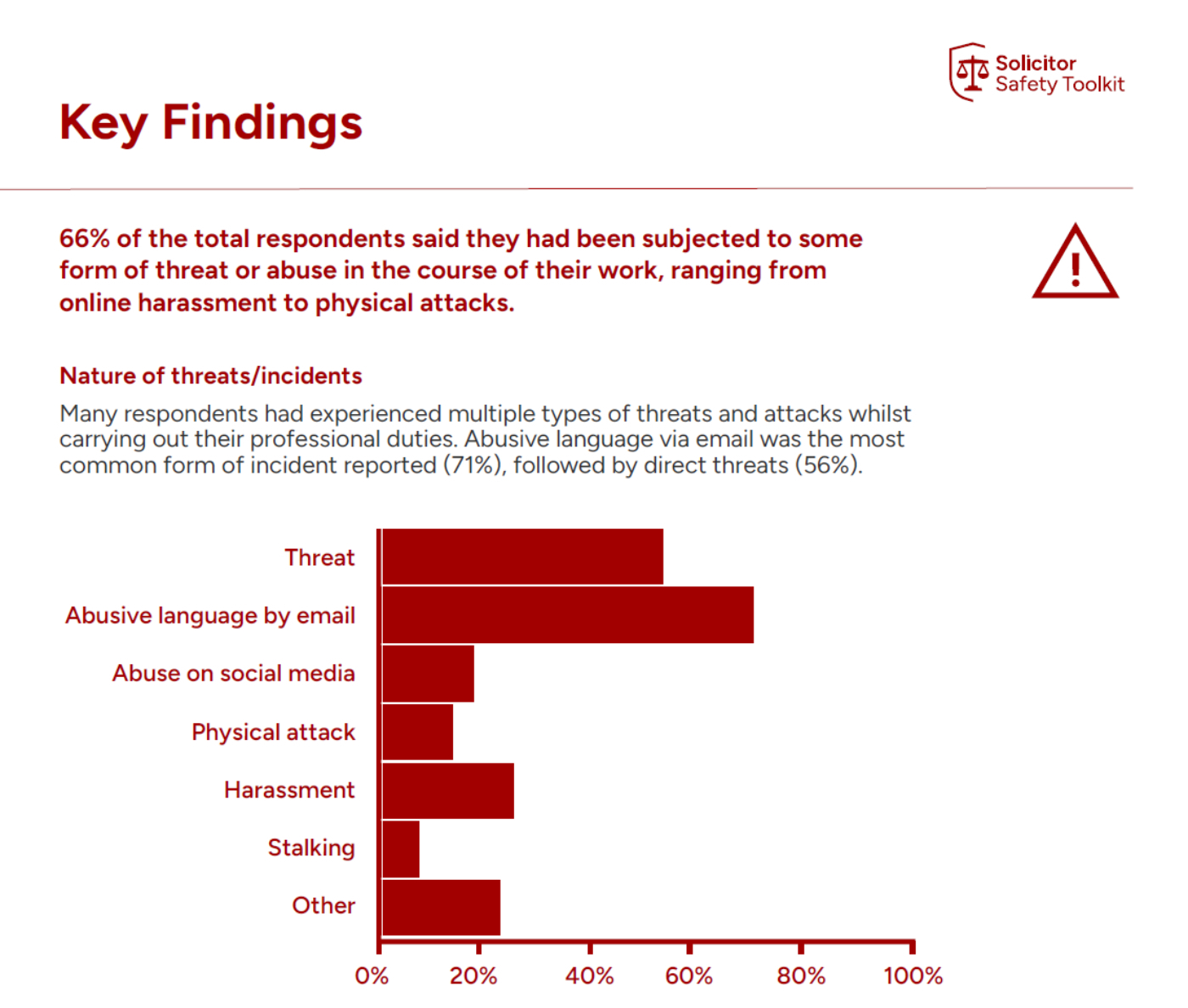
Key Findings
For those who selected ‘other’, a significant majority reported abusive language by phone or in person. A wide range of other behaviour included for example criminal damage, IT hacking, blackmail, threatening letters, and terrorist threats.
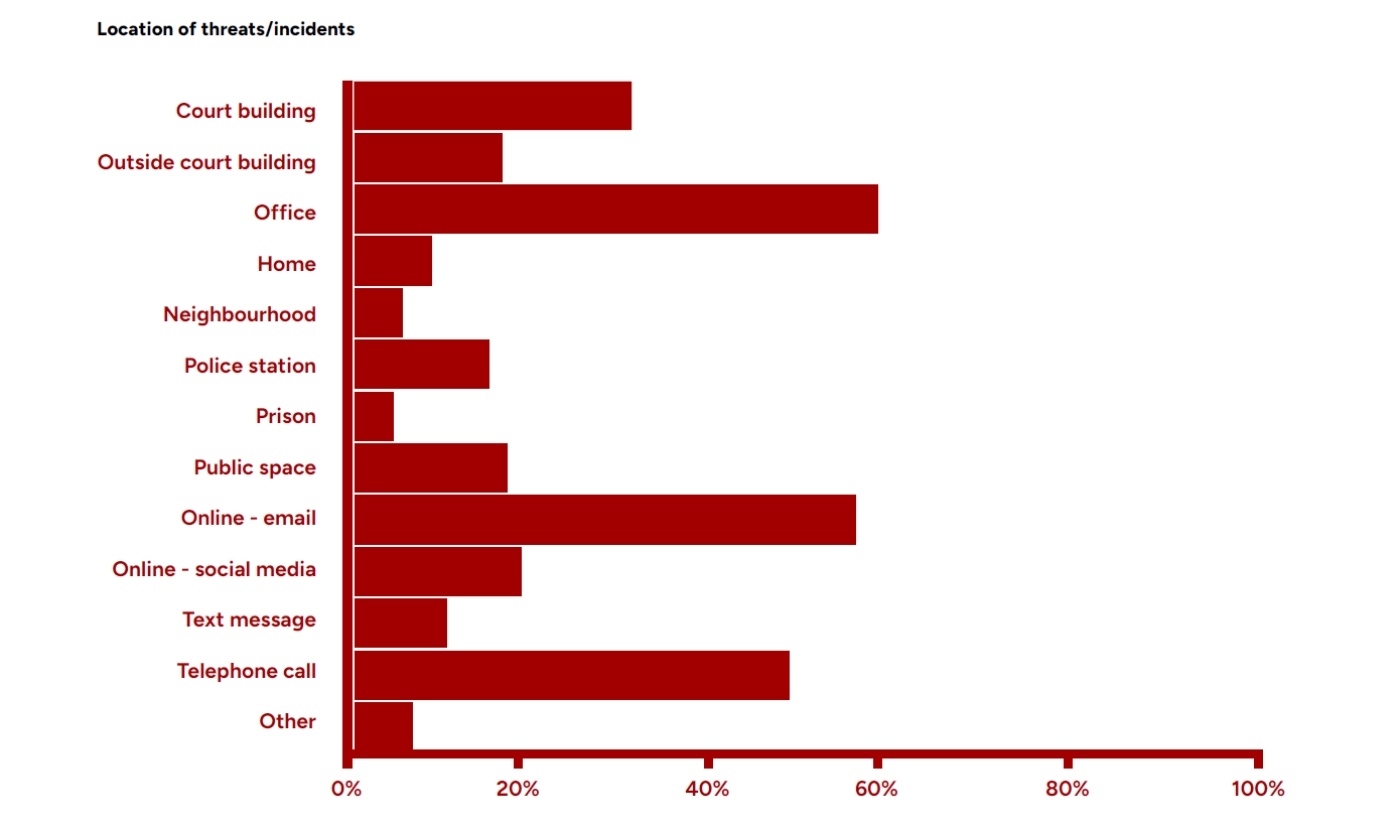
Survey respondents reported that threats and incidents occurred across a range of locations, with the office being the most frequent location (61%), highlighting this as a major risk area. Digital communications were the second most common, including via email, telephone calls and social media. reported that they had been subjected to threats/incidents within or outside a court building (41%).
The Society has established an internal Solicitor Safety Group, bringing together members who have experienced harassment, threats and violence through the course of their work, aimed at driving real change. To date, the Group has undertaken a number of workstreams including:
Direct engagement with policy makers
Engagement with the Minister for Justice and Department of Justice officials, requesting legislative reform to recognise solicitors as frontline workers, making attacks against them a statutory aggravating factor in sentencing.
We have also pressed for the introduction of a statutory presumption against the use of suspended sentences in cases where an officer of the court is the victim of an attack, harassment, stalking, or related conduct, in the upcoming Sentencing Bill and Review.
Engagement with justice stakeholders, including the PSNI, Lady Chief Justice, NICTS, and PPS. This has led to:
Securing an internal Solicitor Safety Group within the PSNI, along with a new reporting mechanism, and dedicated internal officer.
The creation of a Solicitor Safety Liaison Group consisting of representatives from the PSNI, PPS, NICTS and others, aimed at supporting a co-ordinated response to threats and attacks targeted at solicitors, through for example, facilitating inter-agency collaboration.
Changing public attitudes
Promoting the Rule of Law Pledge and Convention on the Protection of Profession of Lawyer to raise awareness of the risks faced by solicitors and the need for respect and protection.